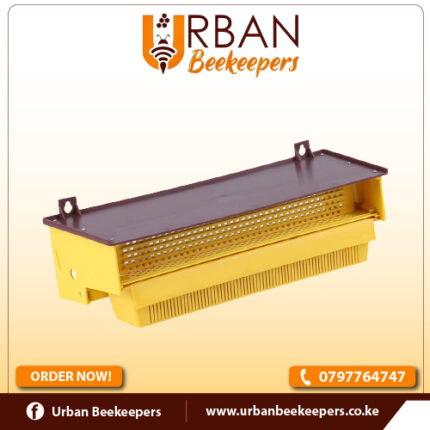






The Entrance Pollen Trap (Drawer Type) is a Langstroth hive accessory used to harvest fresh bee pollen from forager bees as they return to the hive. It fits over the hive entrance and uses a mesh screen to dislodge pollen pellets from the bees’ leg baskets (corbiculae) as they pass through. The pollen falls into a ventilated collection drawer that can be removed and emptied daily or every two days without disturbing the colony.
What Is the Entrance Pollen Trap (Drawer Type)?
Bee pollen is one of the highest-value supplementary products a beekeeper can harvest. Collected pollen pellets are sold as a nutritional supplement, used in apitherapy preparations, and increasingly sought by the health food market across Kenya and for export. The drawer-type entrance pollen trap is the most practical and widely used design for Langstroth hives — it slots onto the existing hive entrance, requires no permanent modification, and allows the beekeeper to start and stop collection simply by opening or blocking the trap mesh. It is used alongside the Pollen Trap with Collection Drawer (a full-base version) for larger hives. For managing colony population and swarming, see also: Bee Lure Swarm Attractant.
Key Features and Technical Specifications
| Specification | Detail |
|---|---|
| Type | Entrance drawer-type pollen trap |
| Compatible Hive | Standard Langstroth hive entrance |
| Collection Method | Mesh screen knocks pollen into ventilated drawer |
| Colony Access | No hive opening required for pollen collection |
| Recommended Use Period | Activate for 2–3 days per week during nectar flows |
Who Needs the Entrance Pollen Trap?
- Commercial Beekeepers Diversifying Income: Pollen harvesting adds a high-margin product line to existing honey operations with minimal additional labour. Daily collection takes under 5 minutes per hive.
- Apitherapy Practitioners: Fresh bee pollen is a core apitherapy product with growing demand from health clinics, sports nutrition, and natural supplement retailers.
- NGO and CBO Value Addition Projects: Adding pollen collection to an existing honey operation increases revenue per hive without requiring additional equipment investment beyond the trap.
How to Use the Entrance Pollen Trap (Drawer Type)
- Fit the trap to the hive entrance. Slot the entrance pollen trap over the standard hive entrance, ensuring the mesh screen is correctly positioned in the flight path of returning foragers.
- Activate the trap. Open the mesh screen to begin collection. Do not run the trap continuously — activate for 2–3 days per week to avoid stressing the colony by depleting pollen reserves needed for brood rearing.
- Collect daily. Remove the drawer every 24–48 hours and transfer pollen to a drying tray. Fresh pollen must be dried immediately to prevent mould — spread thinly and dry at below 40°C.
- Store correctly. Once dry (moisture content below 8%), store pollen in an airtight container in a cool, dark location or in the freezer for long-term preservation.
Why Buy From Urban Beekeepers?
- Kenya’s best beekeeping equipment shop — stocking high-quality and genuine beekeeping equipment
- In stock — same-day delivery within Nairobi
- Nationwide delivery to all major towns across Kenya
- Call or WhatsApp: 0797 764 747
- Trusted by commercial farmers, CBOs, and NGOs across Kenya
- Urban Beekeepers accepts M-Pesa, card, cash and bank transfer payments
Shipping and Delivery
Urban Beekeepers delivers countrywide to Mombasa, Kisumu, Nakuru, Eldoret, Machakos, Kitengela, Kitui, and all major towns across Kenya. Same-day delivery within Nairobi. Call 0797 764 747 to confirm delivery timelines for your location.
Frequently Asked Questions
How much pollen can I collect per hive per day?
Pollen yield depends on colony strength, forager population, and proximity to flowering plants. A strong colony during a good nectar and pollen flow can yield 50–200g of dry pollen per trap per day. Most commercial beekeepers average 20–50g per active hive per day across the collection season.
Does collecting pollen harm the bees?
Pollen traps are designed to collect a portion of incoming pollen — not all of it. Bees pass through the mesh screen and approximately 50–60% of pollen is dislodged into the drawer while the remainder enters the hive. To protect colony health, limit trap activation to 2–3 days per week and deactivate entirely during cold or dry periods when foraging is reduced.
Does Urban Beekeepers deliver the Entrance Pollen Trap outside Nairobi?
Urban Beekeepers delivers countrywide to Mombasa, Kisumu, Nakuru, Eldoret, Machakos, Kitengela, Kitui, and all major towns across Kenya. Same-day delivery within Nairobi. Call 0797 764 747 to confirm delivery timelines.